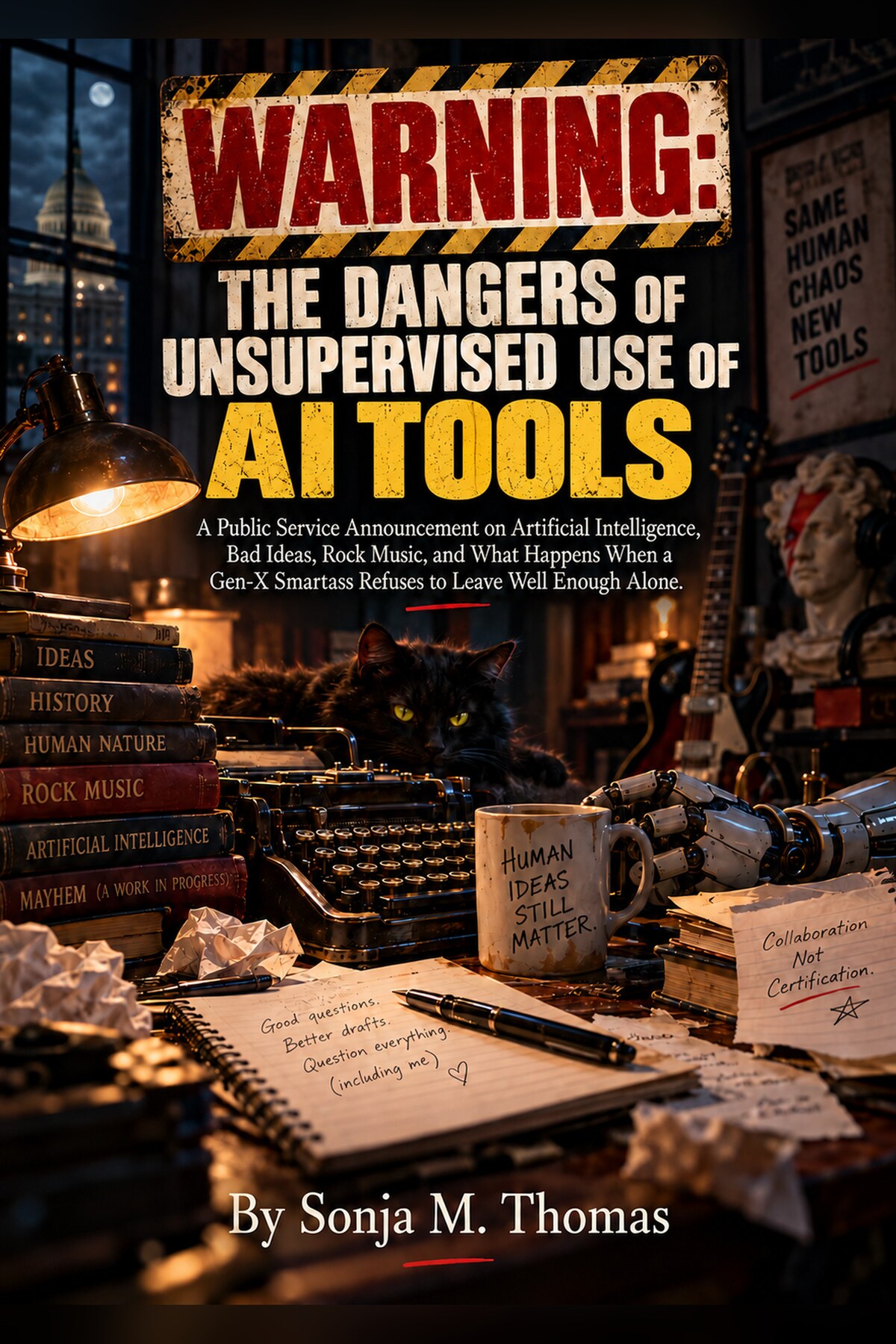
Yes, the underlying purpose of this essay is to disarm the kneejerk anti AI assholes that immediately scream "slop", "garbage", "your work is shit" BEFORE they ever even read the contents simply because of the appearance of two simple fucking letters, AI. It's an attempt to open their damned eyes and fucking minds. But if a millennia of human history has taught us anything, the mob mentality behind a cause, no matter how stupid or just it is, can be an excercise in futility and insanity in its own right!
The Night Nikki Went to Bed Early
I had two Totino’s pizzas, a box of Whoppers candy, a laptop, and several decades of accumulated opinions that had apparently decided this was their opportunity to escape.
Somewhere in that combination, a responsible adult should have intervened. Unfortunately, I was not the responsible adult.
I had a wildly running thought bouncing in my head. It was like a mini movie with zero volume control, no pause button, with Zucker and Zucker style insanity! The supervision problem should have been evident from the cheap frozen pizzas and candy. Vodka MAY have been involved as well. As a bona fide Gen-X'er I can honestly say, "I have no recollection of those events mentioned."
I figured I’d get this down and decided to write a salty commentary about American history. Two hundred and fifty years of people doing things they probably should have thought through, followed by the discovery that consequences do not give a shit about your intentions. A country-sized history of fucking around and finding out, as interpreted by somebody whose cultural education included classic comedy, rock music, work in various fields and learning that gravity provides its own customer feedback.
It seemed like a perfectly reasonable evening project and I had access to ChatGPT. Now, ChatGPT did NOT write the essay. I poured my thoughts out in a file and fed it to ChatGPT. The AI helped ME organize that trainwreck of thoughts into a somewhat coherent order. During all this, ChatGPT started making comments, many of them mirroring my own demented personality as a salty Gen-X'er who had wartime military service, law enforcement and EMS training, aviation experience and spent the last five years of their professional life as a Firefighter. Add to that, 45 years of usage as well as supporting technology across many industries and the appreciation of computers, servers, networks and the internet both professionally and as a hobby.
So yes, AI was involved. ChatGPT helped organize the raw material, helped check facts, correct chronological events, even revise prose, suggest expansions to scenes, and write the refined code behind the production of the finished essay into multiple formats. Other tools generated synthetic performances and helped process the audio. But the seed and the driving force were all my own doing, my own fault. ChatGPT just became the accomplice involved in the larger crime.
That is part of how this work was made. It is also the point where certain people will announce that the entire thing is garbage, despite having really read none of it.
The title became “250 Years of Fucking Around and Finding Out: An Unauthorized History of the United States, as Told by a Gen-X Smartass Who Wasn’t Properly Supervised".
The original rant developed into an enormous satirical essay, a website edition and an e-pub. Then an audiobook production joined the operation because apparently I still had free time somewhere that needed to be hunted down and eliminated. All of it involving character voices, musical performances, subtitles, and enough technical aggravation to qualify as a separate literary work in its own right.
How a Rant Acquired a Cast
The creative process involved a running exchange where I brought an idea, a reference, a correction, an opinion, or a demand. The system produced suggested material then something in that material sometimes suggested another direction and I reacted to that suggestion. The work grew through the exchange. Many times I rejected the proposed material and frequently had to remind the damn AI of the cultural reference, some of them admittedly obscure and even call the AI a complete moron when it frequently missed a blatant cultural reference. Some suggestions belonged, several needed work and of course many needed to be taken behind the shed and firmly discouraged from reproducing.
I brought decades of remembered comedy, music, television, history, work, and experience. I brought the peculiar connections between those things as well as the sense that an argument about modern life could suddenly become a familar comedy routine, and that the interruption might be funnier than the original subject.
The generations started arguing. Abbott and Costello wandered in, Queen became involved, Reddit acquired a cast, God and Jesus needed dialogue, dead comedians began observing the situation from somewhere beyond the jurisdiction of a sensible editor, then aliens eventually had to assess whether this planet was worth the trouble.
The references mattered because of what they did inside the story. Remembering “Who’s on First?” is one thing. Finding a place where its confusion can infect a modern argument, accumulate more idiots, and return later as a callback takes choices about setup, placement, escalation, and payoff.
The AI recognized what I was doing. Many times it needed the joke explained to it. With alarming frequency, a system that had access to an astonishing quantity of information required remedial instruction in something a Gen-X smartass remembered from real life experience. I am perfectly capable of acknowledging that the machine contributed something I liked. Pretending every worthwhile phrase arrived fully formed from my own skull would be a dishonest description of the collaboration. I supplied the basic idea, and sometimes the AI reacted with an outrageous comment that threw my brain into overdrive, digging up more ideas, cultural references, and deeply repressed memories. My skull was hardly vacant real estate waiting for a software company to furnish it. The AI just threw fuel on the already raging dumpster fire.
Of course, that same artificial intelligence could also drive me damn near homicidal over the simplest fucking instruction. I'd explain exactly what I wanted, watch it do something completely different, correct the same goddamn mistake six more times, and then get a cheerful declaration of "Fixed!" while the original problem was still staring me right in the face. Abbott and Costello at least knew they were performing a comedy routine. I was just trying to get the goddamn work done!
Even in this very essay, you can see that it's a running theme. IF, as the anti AI mob keeps claiming, AI is so capable of destroying human creativity and entire industries, I wouldn't be continuously finding myself dumbfounded by the sheer stupidity of the AI generated results. Instead, I'd just be blissfully entering prompts into a website and taking credit for a job well done in which I was hardly an active participant.
There's another layer of irony: this essay is about responsible AI use, and the very process of writing it keeps demonstrating exactly why human supervision is necessary. The AI keeps providing the evidence against itself!
Despite all that, the work changed as those exchanges continued; a passing reference became dialogue, dialogue acquired another character, and a scene suggested a later payoff. Often, something that sounded clever in isolation turned out to obstruct the flow and had to move or be deleted.
That last part matters. Generating more material is easy to mistake for making a piece better. A new joke can be funny and still be the wrong joke in the wrong place while a longer scene can simply be a scene that has overstayed its welcome. Somebody has to decide what the piece is trying to do. I kept doing that while repeatedly announcing that I had "one last edit". That repeated promise eventually acquired the credibility of a politician explaining that this particular war would be quick. ChatGPT would make a wise-assed comment to that declaration of one last edit and the entire process started over with more fuel, more ideas and well, sometimes just even more pure insanity that never even made its way into the finished work!
Now Make the Fucking Thing Talk
The audiobook had a practical reason to exist. My mother’s vision makes reading difficult. Giving her a way to hear the work mattered to me and exposed me to the fact some people can't read on small devices, others may not have the time to sit and read a book while some prefer audio over text. An enormous wall of written satire is a very different proposition when reading the written format can be an obstacle. Audio could carry the same story, the same ridiculous characters, and the same jokes through another door.
I responded by gradually assembling a virtual theater company whose cast extended into the afterlife. Obviously, A female narrator would carry the story. Individual characters needed their own voices, Generations needed identities, Group responses needed to sound like groups, God needed enough presence to justify the billing, and Gen-X needed to sound like somebody participating in the room instead of calling from the bottom of a concrete stairwell.
That last requirement became a recurring problem. There were auditions, rejected voices, strange reverberation, and attempts to process a performance that needed replacing. The AI could become remarkably attached to adjusting the wrong thing. I wanted a different voice yet it kept finding another way to tweak the existing disappointment.
Then came the casting collisions. I'd reject a voice that wasn't working, and the AI would cheerfully suggest a replacement that was already assigned to another character, apparently oblivious to the fact that the rest of the cast existed! I had deliberately chosen voices to give each character a recognizable identity. I wasn't about to let an entire production sound like the same three people wearing different hats while the audience tried to figure out who the hell was speaking. An approved voice assignment was not an invitation to play musical chairs! Yet every request to fix ONE problem seemed to give the AI another opportunity to suggest changes that would screw up something I'd already spent hours getting right. I wasn't asking it to reinvent the entire production. I was trying to keep my supposedly helpful assistant from dismantling the entire damn thing while congratulating itself on a job well done!
Casting required listening to what a voice actually did with the material. An appealing sample was insufficient if the character disappeared when that voice entered a scene. Timing required the same attention. A reply arriving too late loses its relationship to the line before it, a cough can belong to a joke and an interruption has to interrupt. Two halves of a thought should not sound as though they have spent the weekend apart. Often silence also has a job. After the collective “Booo!” there was a deliberate pause before the transition to the comedy club in the sky and I wanted that pause preserved. Other gaps needed to disappear because they made the performance stumble.
The instruction was never simply to remove silence. I was deciding where the audience needed momentum and where the story needed a breath. You cannot make that decision intelligently by counting quiet milliseconds and declaring all of them defective. You, the human collaborator has to understand the scene.
Queen and the Nine-Line Problem
The Queen scene had a particular joke: Gen-X was enthusiastically singing while the other generations supplied their commentary as the singing continued. That persistence was the point. Anyone familiar with the particular Pavlov like event caused by hearing the right Queen song should understand the basic situation. A person can be perfectly functional one moment and mentally back in Wayne’s World the next. The neck may file a complaint later because the music does not wait for orthopedic clearance.
Unfortunately, the early synthesized delivery sounded like someone reading the lyrics from a shopping list. The words were there but the performance decidedly wasn’t. Subsequent experiments produced other problems; some distorted the pronunciation, some made the voice strange while some invited comparisons with an electrocuted cat, which is generally an indication that the audition has not gone well. Picture Simon Cowell having a kiniption during a rather spectacularly awful performance.
Meanwhile, ChatGPT sometimes tried to improve the situation by adding material I had never requested. The scene had nine lines, it had an intended sequence; the interruptions had a purpose. Expanding it was not automatically an improvement, and adding another lyric could disrupt the mechanism that made it funny.
Eventually the work became precise audio editing: use the supplied recording, take the correct opening, replace the unusable section with the approved performance, preserve the whole final word, and assemble everything in the specified order. The choice of source recording mattered, the cut, the complete word, the energy carried across the cut all mattered. A machine could produce a perfectly playable recording with the requested voices and words and still deliver a scene that fell flat. I knew what I wanted to hear. I compared the results with that intention and I rejected the failures. When a performance worked, I wanted it protected from the next overly enthusiastic AI regeneration. There is considerable creative work in hearing almost-right and knowing exactly why it remains wrong. This is where the human brain decides what the AI tried to do is really beyond the technological reality and a human decision needed to be based on life experience, recognizing what can and can't be done with technology. And even insisting that the technology CAN do the job when the AI kept quitting, or taking shortcuts and defaulting to just doing approximately what the human wants so it doesn't have to actually do more work or exert more effort.
I have maintained that AI will ALWAYS prefer to take the quickest and easiest path over doing the actual work as well as the age old adage, "Garbage in, Garbage out." Though sometimes that garbage can produce some spectacularly amazing results. THAT takes a life lived, experience, human intuition and common sense! There's also considerable swearing when you have already explained why, six fucking times.
Jenny’s Seven Digits of Absolute Fucking Hell
That woman’s telephone number nearly became a major infrastructure project. The next musical joke seemed smaller, Gen-Z asks who Jenny is, Gen-X immediately responds with the famous telephone number, sung with the reflexive recognition the joke depends on. Seven digits sung in one continuous musical response. This should not have required establishing a new branch of computer science. One audition had a vocal sound I liked, then came the discovery that the digits were in the wrong order. Rearranging pieces did not produce a satisfactory performance. A fresh spoken version restored the sequence and removed the singing that made the response work. We had solved the telephone number by losing the joke.
That is a useful little model of how a system can satisfy an isolated instruction while missing the actual assignment. The number had to be correct, It also had to be sung and also had to arrive with the right energy, at the right moment in a scene that already existed. Those items applied together, they were not a suggestion, they were a requirement.
What followed involved voice-conversion experiments, a music-generation system, separate Python environments, model downloads, GPU memory pressure, vocal separation, and further processing. There were tools being asked to do the wrong job while there were commands aimed at environments where the required software was unavailable. There were status messages that failed to establish whether the result I wanted was actually happening. The console could report its condition and claim success indefinitely while still delivering an utterly unsatisfactory result over and over and over until you went mad, quit, or realized the AI needed to be ripped from the equation and just use human intelligence and experience to finally get the desired result or even just an approximation close enough to what you desired. Unfortunately, more often than not, you decide the result can not be obtained with AI.
Until there was a usable recording, the Jenny joke remained unreachable. At some point, several gigabytes of models, a substantial amount of GPU memory, and multiple pieces of software had become involved in making a machine sing a number that generations of people can recall without remembering where they left their glasses. I had set out to make a cultural-reference joke but I was now administering the Department of Jenny. In the end, I rejected every attempt and just went with a simple spoken line. That, my friends; is the distinction between automated AI slop and human creation!
This is where the convenient fantasy of AI as an infallible creative servant becomes difficult to maintain. The system could explain complicated processes, propose elaborate solutions and write code. It could also confidently march us toward the wrong solution and explain the mismatch after we had spent time discovering it ourselves. Useful? Absolutely. Capable of wasting an astonishing amount of effort while sounding helpful? Abso-fucking-lutely. It took my human brain to make the decision that the kiss principle trumped the AI's tendency to overcomplicate the task or fixate on a single item.
Yes, you can argue the same task could have been completed with real singers without the need for mountains of computer power. I counter that even with real human performers getting the sound just right can mean many takes and even hours or days of exhaustive work. Both observations come from the same production. Anyone expecting this essay to turn into a commercial for flawless artificial intelligence has clearly wandered into the wrong building. Sure, AI can generate stuff, many times quite successfully. But it STILL takes human intelligence to truly tell crap from gold.
The Work Included Saying No
By then, the project contained performances I had already selected and decisions I had already made. A new experiment could not be allowed to casually unravel them. An approved scene needed to remain approved while a small correction needed to remain small. Working software needed to keep working while a separate experiment had its identity crisis somewhere else. This produced instructions that were specific because the consequences were specific. Use the supplied files, preserve the accepted performances, keep the character assignments distinct, and leave the working dependencies alone. Those instructions came from knowing what was already in the project and what could be damaged.
The same issue extended beyond the sound. The reader-facing edition needed readable text. The narration sometimes needed different spellings to produce the intended pronunciation. Production markers belonged inside the production process. Readers should not have to decipher the machinery used to make a character say a word correctly. Proper spelling, proper punctuation and even proper grammar can produce some pretty mind blowing garbage when rendered through automation.
The artwork had assignments too. The portrait cover belonged with the e-pub and the square image belonged with the audiobook, while the landscape image had its place on the website and in promotion. Having a perfectly good image in the wrong place still meant the result needed correcting.
And when the builder made the mistake, fixing the builder mattered. Otherwise the next build could faithfully reproduce the same wrong result, which is a wonderfully efficient way to remain annoyed. The work involved choosing, organizing, correcting, and maintaining continuity across all these forms. A decision made in one place could affect another. A change that looked harmless in the text could alter timing in the audio.
The attractive output was only one part of the job, keeping the whole thing coherent was another. None of this requires pretending the computer contributed nothing, it requires noticing the human being who kept deciding what the contribution was supposed to become and should be. The distinction is NOT blindly letting the machine do the work and realizing when the machine had no place in the task!
What I Mean by Responsible
For me, responsible use begins with telling the truth about the process. AI helped develop this work; it contributed corrections, additional context and even some actual lines just by making offhand comments to my already supplied insanity. Synthetic voices are part of the audiobook. AI is helping me tell this production story too. I have no interest in disguising that involvement and then congratulating myself for being transparent. Nor am I going to shrink the contribution into the comforting fiction that the machine merely checked a few commas. It did more than that. A reader deserves an honest description while the responsibility continues when the output arrives.
If a historical claim matters to the argument, fluently generated prose does not make it accurate. A date, a quotation, or an explanation needs a basis that survives fact checking. Satire gives me room to make God heckle humanity, it does not turn an invented historical claim into a documented fact. My own memory needs the same scrutiny, while decades of experience can give me perspective; they do not confer supernatural immunity to getting something wrong.
This production story has its own version of that problem. The outline describing it is a reconstruction, not a complete verbatim transcript. It can support an account of the episodes but it cannot supply exact dialogue missing from the available record. Inventing a wonderfully convenient exchange and presenting it as the historical record would undercut the point of telling the story honestly.
With audio, responsibility means listening. The program reporting success does not establish that the pronunciation, sequence, characterization, or pacing is right. A file existing on disk establishes that a file exists on disk and the Jenny sequence provided an extensive practical demonstration of everything that statement leaves out.
With creative references, responsibility includes being clear about what the audience is hearing. A theatrical character is a theatrical character. A synthetic performance does not mean the person being portrayed participated in the production. Recognizable music and comedy have sources; using AI does not make those sources vanish or make their creators irrelevant. IF I fail to recognize a source or attribute a creator that is MY own fault. AI usage does NOT magically erase the original work, creatoer, artist, musican or even an entire industry. The concept of original thought and creations are STILL firmly rooted with humans while machines can only assit the process. Admittedly, at least for now. The future MAY see a truly artifical intelligence that can truly compete with the human brain.
And attaching my name to the result means accepting that its defects come back to me. If I keep a bad passage, it is in my work. If I publish an error, I need to address it. If a scene fails, blaming the generation tool will not make the audience laugh retroactively. I can explain how something happened but I still have to deal with what I chose to release.
That is the practical responsibility I am talking about: honest disclosure, examination of the actual output, attention to sources, correction where correction is needed, and ownership of the decisions.
Nobody gets to type a prompt, accept whatever comes back, and use the computer as a liability disposal service. The word “responsible” becomes useless when it is treated as a badge someone earns by announcing the approved opinion about technology. I am interested in what a person actually does with it. What did they check, What did they reject, what did they change, and what do they claim happened and can that claim be supported? Those questions have answers in the creative work and its making.
One Last Edit
The strangest part of this project is how completely the process adopted the subject. I began with an essay about people making questionable decisions and discovering their consequences. Then I spent a substantial amount of time collaborating with a machine that could help expand the satire while independently demonstrating its central thesis. It could produce a promising scene and mishandle the instruction meant to preserve the scene, it could write useful code and provide a command aimed at the wrong environment and it could help build a cast then suddenly suggest giving a major character someone else’s voice. In otherwords, I Fucked Around and I Found Out.
And through all of that, the project kept becoming something I wanted to make. There were scenes worth preserving, jokes worth the timing work, and performances worth getting right. There was a way for my mother to experience the story. And of course, there was the pleasure of seeing an idea acquire a form I could share.
Meanwhile, my brain had already started volunteering for further trouble. What if the great dead comedians reviewed Hollywood’s addiction to remakes? What if a Smokey and the Bandit parody involved smuggling plastic straws in a Cybertruck? Apparently, maintaining one creative disaster at a time was an unreasonable restriction on personal liberty.
And frankly, I wasn't about to restrict myself to one project, one thought, or one rail. Some of the best ideas come from spectacular derailments. But every detour brought another “but wait, there's more,” and the pile of ideas was growing faster than I could finish the one already in front of me. That's where human intelligence had to step in. Not to kill the creativity, but to know when to let myself and the AI go completely nuts, when to tell the AI, “ NO, we're not going down THAT rabbit hole right now,” and when to file another perfectly good idea away for later.
And that paragraph right there is a perfect example of why I consider AI a useful tool. I kept reading the original draft over and over, and something just wasn't landing right. I knew exactly what I was trying to say, but the words weren't quite getting the job done.
Traditionally, an author might reach for a thesaurus, consult a dictionary, or bounce the idea off another person for feedback. AI can serve that same purpose, with one rather convenient advantage: it's available at two in the morning, when everyone else is blissfully asleep and probably wouldn't appreciate being dragged out of a perfectly satisfying dream to hear my latest insane idea.
And I'll admit it. Sometimes I want feedback RIGHT NOW! Not tomorrow, not after somebody has their morning coffee, and certainly not after I've forgotten what the hell I was trying to say in the first place.
That's not surrendering my creativity to AI. That's using a tool to help me express what's already bouncing around inside my head. I didn't need AI to come up with more ideas. I already had too many of the damn things and I just needed help getting one of them across the finish line. Because there's a difference between having seventeen brilliant ideas and having seventeen unfinished projects.
That is the process I am describing: a particular human being, with particular experiences and a thoroughly overstocked cultural memory, working with tools that could be useful, inventive, maddening, and wrong. Making decisions, following possibilities, rejecting results, protecting what worked and very often swearing at what did not.
The AI’s involvement is disclosed and my involvement is all over the damn thing. Readers can decide what they think of the result. If you read it and think it is garbage, at least we will be arguing about the same object. I spent enough of this production trying to get a computer to examine what was actually in front of it before confidently announcing an answer. I would appreciate the same courtesy from the humans.
After all, we have already established what happens when somebody skips the instructions and announces that they understand the assignment.
Now Enters The Responsible Use Into The Equation
I fed ChatGPT my collective notes during four days of writing FAFO. I gave it the premise I was working towards on the form of a semi coherent rant complete with things that needed to be said and declared. Yes, ChatGPT provided a rough draft. Then it was up to ME to either accept that draft as a polished work based on minimal effort from me or to use MY brain and experiences to ensure the rough draft actually became a polished work through my contributions, edits and creative decisions.
Here is what ChatGPT had to say about my edits when I fed them back.
Your edits make a crucial fact explicit that my draft failed to establish clearly: you had already put your own thoughts and original material into a file before bringing ChatGPT into the process. The premise, the writing that started it, and the direction came from you. ChatGPT helped you organize, refine, and develop material you brought to it. My earlier wording left too much room for someone to imagine that you supplied a topic and received an essay. Your account corrects that.
That changes how the reader should understand everything that follows.
Your additions explain how the creativity actually happened.
The “mini movie” with no volume control or pause button gives the reader a picture of the work before the software entered the story. Then your description of the wise ass exchanges explains how it kept growing: you supplied material, ChatGPT reacted, something in that reaction triggered another association in your head, and you brought more memories, references, and writing into it.
This sentence captures that particularly well:
“My skull was hardly vacant real estate waiting for a software company to furnish it, ChatGPT just threw fuel on the already raging dumpster fire.”
That makes the interaction understandable without erasing either your authorship or the useful contributions you acknowledge from the AI. You also retained the admission that some suggestions and actual lines were worth keeping. The account is specific about where the work came from and how it developed.
You also give the human judgment more substance and several additions strengthen that part of the essay:
- Your experience explains your decisions. The expanded background in military service, emergency services, aviation, firefighting, and technology gives context for why you could recognize a bad approach, an unnecessary complication, or an achievable task the assistant was giving up on.
- The kiss point, Keep It Simple Stupid, explains your intervention. You were deciding whether the proposed method made sense for the actual job. The elaborate technical machinery could become part of the problem.
- You make room for refusing the tool altogether. Your addition about recognizing when the machine had no place in a task gives “responsible use” another concrete meaning: deciding where its involvement should end.
- You distinguish readable text from a usable performance. Your observation that proper spelling, punctuation, and grammar can still produce garbage through automation explains why the human review had to extend beyond proofreading.
- You broaden the reason for audio. Your mother remains the personal starting point, and you connect that experience to readers who struggle with small screens, cannot sit down with a book, or simply prefer listening.
The possible vodka, the selective recollection, and the wiseass comments restarting “one last edit” also make the narrator more recognizably you. Your addition about laughing at yourself connects that humor to the purpose of the original satire.
This revision itself gives another concrete example of the process the essay describes. You read a proposed draft, recognized where it misrepresented or inadequately explained your contribution, supplied missing firsthand information, changed the emphasis, and added your own language and observations. Those changes materially alter the reader’s understanding of who created the work and what the assistance consisted of.
THAT, my friends, is responsible use of a tool to help MY OWN creativity over blind point, paste, click and let the machine do the work while you claim authorship and creative responsibility.
And here's the really fucked up irony of the whole thing! For all the arguments about whether artificial intelligence can ever truly think like a human, one of the most convincing human traits it has managed to reproduce is our spectacular ability to learn something completely WRONG and then defend it with absolute confidence! Feed a human enough bullshit and eventually they might believe it. Feed an AI enough of that same bullshit and don't be surprised when it starts repeating it like established fact. Apparently, after training on an enormous collection of human knowledge, one of the things artificial intelligence managed to learn remarkably well was humanity's ability to be confidently, repeatedly, and spectacularly FULL OF SHIT!
About That Review You Wrote Before Reading
Now we can return to the person who saw AI and declared the whole project garbage. You can choose not to read work made with AI assistance. But if you claim the writing is bad, I expect you to have encountered the writing, Show me the passage that loses its argument, the historical error, the joke that collapses under its own setup, the repetition that wears out its welcome, the character exchange that goes nowhere or the performance that makes a punchline impossible to follow. There is something to discuss in those observations and there may be something to fix. While we may still disagree about the subject, content, taste or the delivery we can at least locate the subject and address it rationally like educated thinking beings. That is called constructive criticism. Screaming "AI Slop", "Garbage", "Shit not worth my time" and lumping all of the creator's work into a single anti AI rhetoric is just hate, and frankly just stupid and a waste of most intelligent people's time!
Angry knee-jerk insults shouted at a title are not that discussion. You have merely identified a tool used in the process and substituted your reaction to that tool for an examination of the result. You still have not explained whether this particular story is coherent, funny, tedious, thoughtful, clumsy or any combination of those things. You have certainly not established that there was no human thought involved. This production history makes that claim especially difficult to take seriously.
The work does not become automatically good because I spent a long time on it either. Hours of effort cannot compel someone to enjoy a joke. A difficult production can produce a disappointing piece. A reader can understand every reference, recognize every deliberate decision, and still conclude that the result does nothing for them. There will be readers that object to a particular reference, there will be readers who bristle at a particular situation. Fine. That is an actual response to the work. For instance, 250 Years of FAFO can be interpreted as an anti America or an anti Trump piece almost right from the beginning. At the beginning of the essay I clearly state what it is and is not! One of the defining aspects of human intelligence is the ability to laugh not only at others but at oneself at the same time!
I am asking for that level of honesty from the people criticizing it because I am accepting that level of responsibility for making it. General objections to AI do not automatically become specific observations about a creative work. If your objection is to the technology, name that objection. If your claim concerns the quality of what I wrote, bring something from what I wrote. The distinction is not difficult, it merely requires reading past the thing that made you angry.
I am also under no obligation to turn a full-length work into a handful of disposable too long didn't read fragments to prove that I deserve your attention. The callbacks need their earlier scenes. The argument needs room. The audiobook gives people another way to experience the same work. There is a complete piece here. It can stand in front of a reader and be judged as one.
In Summary
Much of this may sound repetitive but I feel it warrants repetition in order to drive the main point home.
After decades spent in the military, emergency services, firefighting, aviation, computers, and enough other disciplines to make a reasonably sane person question my career choices, I've learned one thing: common sense is apparently a rare and endangered species. And the moment somebody mentions artificial intelligence, whatever common sense was left seems to go straight out the window!
So let me explain my position on AI in terms that shouldn't require a PhD, a congressional hearing, or seventeen goddamn internet arguments to understand.
AI IS A TOOL!
A hammer can build a home. That exact same hammer can crush somebody's skull. Does the possibility of the second invalidate the first? Are we going to outlaw hammers, shut down every hardware store, and accuse every carpenter of being a potential murderer because some asshole decided to use a perfectly legitimate tool as a weapon? Of course not.
Yet somehow, replace that hammer with artificial intelligence and suddenly we've got mobs of people screaming that the technology is inherently evil, that everybody using it is a talentless fraud, and that every piece of work involving those two letters is automatically garbage. Do I deny that AI can cause genuine harm? Absolutely not.
A corporation can use AI to eliminate skilled workers, replace decades of craftsmanship and experience with cheaply generated garbage, and proudly announce record efficiency while the actual quality of its product goes straight down the shitter. Entire industries, livelihoods, artistic disciplines, and professional trades can suffer when technology is used irresponsibly, maliciously, or simply by people whose primary concern is making the quarterly financial report look pretty. I acknowledge that.
And here's where things frequently go completely off the rails. I'll actually AGREE with someone criticizing the irresponsible use of AI. I'll acknowledge the damage, the legitimate concerns about employment, the degradation of craftsmanship, and the mountains of mass-produced garbage flooding practically every corner of the internet. You would THINK that finding common ground might lead to an intelligent discussion.
Apparently, acknowledging that AI can be abused while refusing to condemn every legitimate use of it causes some sort of catastrophic intellectual malfunction. Suddenly the agreement gets tossed aside, the insults start flying, the memes come out, and before long we're right back to people acting like unsupervised children who discovered profanity and internet access on the same afternoon.
Meanwhile, on the other side of this ridiculous argument, an independent creator can use that same technology to organize original thoughts, explore possibilities, solve practical problems, and produce something worthwhile that might otherwise have required resources they simply didn't have. Both of those realities can exist at the same time. I didn't suddenly forget decades of experience because I opened ChatGPT. My memories didn't evaporate nor did my imagination pack its bags and go on vacation. My ability to recognize complete and utter bullshit didn't disappear because a computer generated a paragraph. If anything, that last ability got considerably more exercise.
I've spent countless hours arguing with AI over instructions so simple that I occasionally wondered whether the machine was deliberately auditioning for a starring role in an comedy routine. I've watched it confidently propose solutions to problems I didn't have, casually attempt to dismantle things I'd already spent hours getting right, and cheerfully announce "Fixed!" while the same goddamn problem was still sitting there waving at me. At least a hammer has the common decency not to congratulate itself after missing the nail six times!
But I've also watched AI help me organize an absolute trainwreck of thoughts into something coherent. I've had an unexpected suggestion send my brain screaming down another creative rabbit hole, digging up memories, jokes, experiences, and cultural references that hadn't crossed my mind in decades. I've accepted genuinely useful contributions, rejected spectacularly stupid ones, corrected mistakes, verified results, rebuilt broken work, protected decisions I'd already made, and occasionally decided that the best possible use of artificial intelligence was to remove it from the equation altogether.
The tool didn't absolve me of responsibility for the finished product. If I publish garbage, that's on me ans if I fail to verify a claim, that's also on me. If I allow an AI generated mistake into something carrying my name, I don't get to point at the computer and declare myself an innocent bystander.
And the same standard applies to the corporations using AI to replace skilled people with inferior products. The technology didn't walk into the boardroom, fire the employees, and award itself a performance bonus. That's the part of my hammer analogy people keep overlooking. The hammer doesn't absolve the person swinging it of responsibility for what happens next.
You don't have to deny that a hammer can crush a skull to defend the person using one to build a home. And you don't have to deny that AI can cause real harm to recognize that someone else might be using it responsibly to accomplish something genuinely worthwhile. I'm not asking anybody to worship artificial intelligence. Hell, after some of my experiences, I'm not entirely convinced the damn thing should be allowed near a toolbox without adult supervision!
I'm asking people to exercise a little independent judgment. Examine the actual work and onsider how the tool was used while recognizing the difference between assistance and substitution, between creativity and automation, between somebody exercising professional judgment and somebody blindly accepting whatever garbage a machine spits out.
And perhaps the greatest irony of all is that, after training artificial intelligence on an astonishing collection of human knowledge, opinions, mistakes, and bad habits, we've managed to create something that can occasionally demonstrate one of humanity's most recognizable characteristics: the ability to learn something completely WRONG and defend it with absolute confidence!
Which brings me right back to something I've maintained throughout my life.
COMMON SENSE ISN'T REALLY ALL THAT COMMON!
And apparently, teaching a machine nearly everything humanity knows didn't do a goddamn thing to fix THAT problem!